 return
to archive return
to archive
commentary on D i d e r o t ' s S
a l o n o f 1767
|
|
It was
in 1737 that the Salon became a regular event. The term
'Salon' derives from the 'Salon Carré', a set
of rooms in the Louvre. Between 1737 and 1743 the exhibitions
were held annually. From 1748 until 1795 they were biennial
events. they opened on august 25, the King's name day
and they lasted through September. Members of the Académie
Royale were entitled to enter work. The exhibition was
free, and a large section of the populace would pay
a visit - indeed it was in reality the only opportunity
the public had to view contemporary work. The exhibition
was accompanied by a 'livret', a catalogue, literally
a list of the works displayed. While these exhibitions
were reviewed in newspapers and journals from the outset,
it was not until Grimm, in his Correspondance Littéraire,
and eventually Diderot, in his Salons , began writing
about the works that any relationship to the word 'criticism',
as we understand it, ensued. |
Diderot's introduction to this
discussion of Vernet's work in his salon of 1767 describes
his coming upon a social gathering of culturally optimistic
people discussing the merits or otherwise of poetry,
of art and of philosophy in a genteel and idyllic rustic
setting. Diderot's writing is conversational and abundant
in social observation. He talks about the leisure of
a 'discerning clientele' indulging in the discussion
of intellectual pursuits in a rural situation. a bacchanalian
academy set in paradise. But Diderot hints at a certain
coarseness of argument coming from them : they are disorganised
and their arguments 'circular'. Diderot is at pains
to set these apart from a real intelligentsia. They
are onlookers, part of the 'crowd scene'. Diderot though,
is 'focused'. From one of this group Diderot selects
his - as he calls him, cicerone . Diderot's a/illusion to Cicero paradoxically
warns the reader of some possible journey, feat, memory,
place which will have a significance in the future.
diderot is on holiday [en vacance]. [As in his Conversation
on the Natural Son, he is 'on leave', 'relaxed', 'uninhibited',
- away from d'Alembert, Buffon and the rest of his Parisian
circle. Perhaps he can allow himself a certain latitude,
a certain freedom of expression? A certain licence/permission,
perhaps to test some boundaries? - to move out of the
'picture' of conventional criticism and move across/through
the frame to a landscape of fantasy and critical laissez-faire?].
This sense of licence was at the heart of the whole
notion of Diderot's choice of critical subject. Eighteenth
century French paintings were subject to a hierarchy
of genres. History painting, such as Fragonard's Corséus
and Callirhoé was certainly judged to be intellectually
superior to landscape paintings such as Vernet's. It
was a question of 'events' versus 'appearances'. However
in the eighteenth century the artist's role as mediator
between art and reality began to be reassessed, as can
be inferred from this comment by Joshua Reynolds . .
|
|
|
Whether it is the human figure, an animal
or even inanimate objects, there is nothing, however
uncompromising in appearance, but may be raised into
dignity, convey sentiment, and produce emotion, in the
hands of a painter of genius
|
Landscape painting's rise in importance was
linked to the emerging interest in the ideal, [ as distinct
from ideal models] and the argument that it has the
power to select and reorganise the real in order to
attain a selective imitation, and, eventually, the sublime.
These matters are discussed and defined in Batteux's
Les beaux Arts Réduits a un même principe.
As the principal genres were organised in a hierarchy,
so were the individual categories sub-divided. landscape
painting was itself divided into the 'heroic' and the
'pastoral'. Landscape painting, and its necessity of
observation at first hand also loosened the grip of
'le Maître' on the pupil. It also encouraged the
importance of the notion of the 'personal response'
and the three-way pact of nature, the artist, and the
viewer [and the viewer's response to the picture and
the possibility of the picture stimulating the viewer
into imagining their own response to the scene, and
how that would differ from the artist's]. This interest
in observation and the senses came in the first instance
from Locke in his thesis that all knowledge was derived
from the information gathered by the senses, and then
particularly by Diderot and condillac in France. In
his introduction to the Encyclopédie, Diderot
emphasises the power of observation to reveal the truth.
knowledge was the result of the mind's comparisons of
different observations. Visual experience became the
subject of a whole new range of subject matter such
as his essay entitled Letter on the Blind, and particularly
in his Salons. Diderot , like Reynolds, felt that every
object in nature was a potential subject for the artist.
In his 'composition, 1753', he discusses the organic,
interdependent nature of the objects inside the painting
[the discussion of the rose]. For Diderot, the painting
had to exhibit the same organic unity as did nature,
where everything had its own place and functional rhetoric
- the commonplace, manners. the painting was a mimic
of the organisation of the world as well as the resemblance
of it. Diderot was making a point that painting was
moving towards a situation where the organisation, not
the subject, was paramount.
Diderot then
plays one of his 'distancing games'. He writes a critical
commentary and inserts it as a precursor to the type
of analysis he will eventually use in his discussion
and description of Vernet's work . A pre-echo, a preface.
Diderot will serve up this game several times more.
. . . . He starts his piece by making disparaging remarks
about his ability to do the works justice. He apologises
in advance for his 'rash comments'. he promises a promenade
rich in error and misjudgment. Diderot is in reality
already distancing himself from the notion of himself,
encouraging the reader to disassociate his remarks,
and see them as mere entrances, opening gambits whose
calculated naiveté provide a platform, a scene
for 'Diderot' to come to the rescue. There is already
a conversation piece in the making.
.
|
|
|
. . . I
felt my movement suddenly checked
|
|
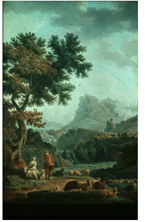
The Shepherdess of the
Alps 1763
|
|
. . . . . . . . to the right, in the distance
, a mountain summit rose to meet the clouds
at
this moment chance had placed a traveller there, upright
and serene.
The traveller fulfils the role of the
'focal point'.
The base of the mountain is obscured
by a mass of rock
the rock stretches across the
view . . .
|
the first site
Diderot begins to let slip his 'confusion' between the
painting and the scene. The scene is endless, infinite.
There is no 'edge' to this view. Only something artificial,
contrived, can have an 'edge' to it. |
|
. . . . . this severs the foreground from
the background
On the far right, on a rocky outcrop
two fishermen are in conversation.
Extending into
the distance there is an embankment, along which a wagon
makes its way to the distant village.
|
Diderot
then arranges for his cicerone to ask him if an artist
such as Vernet could have improved upon this scene.
With a clump of trees perhaps placed in a well-mannered
position? Would he have been able to render the subtleties
of light? Of course replies Diderot, of course he would,
has he not invariably succeeded in the past? Diderot's
use of the phrase 'well mannered' hints at a discursive,
rhetorical reaction to the forming of a relationship
between picture and scene. He seems to be at once guarding
against the temptations of augmentation. As augmentation
lends grandeur to the insignificant, taken 'to its highest
degree', or sometimes 'even beyond it', it moves out
of the realms of the ordered into that of the wild and
uncontrollable. There is then a parallel mimicry created
: that of the movement between the frame of picture
and scene, and the movement in and through their frame
of 'acceptable' discourse. Perhaps Diderot was mindful
of the danger in this augmentation, a situation where
'words must necessarily fail him' , the sudden unavailability
of a vocabulary to continue with his argument. That
the augmentation of [in] the language would create a
limit on the augmentation of the meaning. Decorum therefore
can't have a positional view in the sense of a 'stance',
it must [must] instead generate its own sense of appropriateness.
Diderot's fear of augmentation mirrors his subject.
He seems to be seeing augmentation as a property whose
life depends on the frugality of its usage, but whose
effect demands maximum exposure, possibly a mechanism
for infiltrating the discursive by the figurative. His
plea for something beyond the superlative brings him
in conflict with duration. He has to sever the repetition
of augmentation in order to pass through the finality
of the superlative. whereas augmentation feeds on gradation
and what can be termed 'appropriateness', this 'supra'
superlative can never be part of the superlative that
it cannot exist without.
This causes Diderot to
retreat, to move a step back, inside the frame of decorum
[itself the scene of augmentation]. He confronts his
own politesse, manifested in the gradation of the polite
[ Latin politus, polished] through the textures of gradation
[a gradation which is only completely possible through
the visual or the oral, discourse always has unequal
[rude] 'spaces' between the words] which could be described
in terms of 'the genuinely polite', the 'extremely polite',
the 'quite polite'. The measure [measured] of its politeness
related to the appropriate level of politeness deemed
necessary at the time and in those particular circumstances
[at the place], and from this the calculation [a politeness
in itself] of the corridor, the no man's land separating
[joining] the frontiers through which [nervously] progress
is made. Augmentation therefore insists on compliance
with a legislature of limitation. A statute [from Old French estatut, from Late Latin stattum, from Latin statuere to set up, decree, ultimately
from stare to stand], returning augmentation
back into the arms of sententiousness, a mechanism for
limiting the 'mostness' of the most. Forte!
Forte! Forte!
Schumann would later demand. Manners, propriety, 'the
proper', 'the polite' must also present themselves for
an aesthetic interrogation. Propriety/proportion. A
different reason for commencement and termination, concealment
and display, frugality and exposure.
Diderot plays
with the reader's suspicions when he gives the air of
only being half interested in this conversation. the
main thrust of his perceptions, he tells us, is concerned
with a small part of the scene, a microcosm, a model
of the whole. In one example, diderot picks out a torrent
of water, then tells his cicerone to go back to the
Salon where he will find the subject of this scene.
Yes, the subject, not the object - for the painting
has included in it an extra, a supplement, in the form
of a wisp of cloud which by its position in space clarifies
the disorder of the previously perceived nature. Diderot
uses this device to be able to revisit the paintings,
or at least to put himself in the position in the scene,
to open up a space between the view and the work that
had its own territory, its own legitimisation. Vernet's
paintings are not, he is saying, 'actualities'. They
are combinations of reality reconvened to give a particular
effect. To be convincing , they must be in accordance
with the laws of nature, and, paradoxically, in order
to do this they must create a scene of independent legitimisation
through which these fragments are filtered. Diderot
is claiming here that Vernet has an instinctive knowledge
of nature's laws, and was therefore able, and with justification
to summon up the correct 'piece' to insert at any time.
This enabled him to think of the landscape in terms
of a 'sense impression', a ground on which to improvise.
The debate between the "beautiful"
and the "picturesque", which culminated in
the great controversy of the 1790s, has its roots in
the early and mid-18th century. Diderot seems to be
arguing for a space between the landscape and the picture.
A half way house. A place where each situation can reflect
on each other. A model. In essence, figurally, a garden.
It is no coincidence that contemporary to Diderot's
salon pieces were earnest debates as to the finer details
of how a landscape should be designed, and how such
a landscape could and should be perceived. To some extent,
the argument polarises in Richard Payne Knight's distinction
between the linear and the painterly, the clear and
the unclear, the 'beautiful' and the picturesque' [
and later in the beautiful and the sublime]: whereas
sculpture and poetry require order and regularity 'painting
and music delight in wild and irregular variety' - thus
addressing themselves to sight and hearing respectively,
and producing 'merely' sensual pleasure. The argument
implies that the picturesque depends less on the nature
of the whole than on visual and tactile/visual - such
effects as the 'smooth' lawn and other properties inherent
in that whole : the picturesque is merely that kind
of beauty which belongs exclusively to the sense of
vision, or to the imagination guided by that sense.
The notion of 'poetic invention' is assumed to
be linked primarily to visual images, a view confirmed
by the essayist Joseph Addison, [1672-1719 ], there
is no Single Image in the Fancy that did not make its
first Entrance through the Sight
The visualisation
of a scene was regarded as an indication of the highest
achievement of poetry. The popularisation, in the 18th
century, of Plutarch's reported quotation from Simonides
that painting is silent poetry, and poetry a speaking
picture suggests a parallelism between poetry and painting
that committed poetry to what Coleridge later described
as 'the despotism of the eye', and painting (as well
as landscape garden design) to a poetic/moral content
ad extra that received its most articulate expression
in the works of the picturesque theorists such as Capability
Brown and William Kent.
Classical landscape paintings
such as those of Claude were popular in the 18th century
because of their explicit content. Natural landscape
could be seen to possess, on the one hand, structured
harmony that could be associated with landscape painting
or, on the other, wild disorder redolent of the sublime.
A third option would be, of course, a balance of the
two. In any case, intention whether human or divine,
artful or natural, is implicit : the poetic force of
landscape is contained in what is, not in what it can
be seen to say : Vernet, or 'Vernet seen through Diderot's
eyes', or rather 'his mind', supersedes the portioning
of nature into gardens by an approach to nature which
sees it as neither garden nor natural landscape. But
to define an aesthetic that fully encompasses the structure
and intention of a garden, notice must be taken of the
physiological approach to the nature of beauty and how
such an approach developed from a visual rhetoric and
its consequent critiques of symmetry, harmony and variety.
The contemporary controversy over the notion of favouring
of the 'belts, clumps and vapid lawns' of Launcelot
Brown, and the straight avenues and parterres of 'old',
especially Italian, gardens is encapsulated in the debate
over 'false taste' and 'modern gardening' , a criticism
of which forms much of the basis for a theory of the
picturesque. Published in 1725, Francis Hutcheson's
Inquiry into the Origin of Our Ideas of Beauty and Virtue
is one of the first systematic works of modern aesthetics.
Distinguishing between 'simple' and 'complex' Ideas
of Objects, he talks of the 'Diversity of Fancy' concerning
the latter, a diversity which leads to 'Far greater
Pleasures', an inherent ingredient of a 'Sense of Beauty'.
An open plain 'not diversified by Woods, Hills, Water,
Buildings', he argues, is less pleasurable than a 'fine
landskip'. It is the appreciation of complex ideas (and
he cites gardens as an example of such ideas) which
forms 'a fine Genius or Taste', and which leads towards
an experience of the beautiful. The difference between
external sense, to which objects can give no pleasure,
and internal sense, is crucial in this respect: internal
sense is the 'passive power of receiving Ideas of Beauty
from all Objects in which there is Uniformity amidst
Variety'. Beauty is thus created by figures in which
there is 'Uniformity amidst Variety'.
Hutcheson
extends the notion of imitation to include imitation
by intention or idea rather than of a natural object
alone, so that beauty can be induced by 'Correspondence
to some universally supposed intention of the Artificer'.
He then goes ahead to use a gardening illustration:
artists may not attain highest intention simply by imitating
'original beauty' (that is, by imitating objects), because
'relative Beauty' (that is, imitation of intention)
with a degree of 'original Beauty' could give greater
pleasure, and therefore a higher sense of beauty. He
adds: 'Regularity in laying out of Gardens in Parterres,
Vistas, parallel walks, is often neglected to obtain
an Imitation of Nature even in some of its Wildernesses'.
But there is a paradox here, a paradox that underlies
picturesque theory: how can natural irregularity be
designed?
This obvious need for the construction
of a language of contrast and harmony developed into
such notions as 'Prospects' and 'Solitude' : In effect,
open views of landscape and enclosed areas within gardens.
But inside this argument of contrasts there must be
a place of harmony, a 'mean Pleasure' . . the midway
point where the senses can rest in equilibrium. The
landscape, or 'Situation' as it was sometimes termed,
should reject extremes, otherwise the senses would 'pall
and be displeas'd'. This notion of constrained opposites
is similar to Shaftesbury's 'compos'd' and 'accidental'
and indeed to Horace's 'simplex munditiis' translated
as 'unaffected Simplicity and Neatness, a noble Elegance
and Decency, a due Proportion, demonstrating the beautiful,
and harmonious Rules of Symmetry and Variety'. Ideally
then the beauties of formal gardens lie 'within a narrow
compass', while the mind 'requires something else to
gratify her' and is satisfied more in natural landscape
where the eye can wander up and down 'without Confinement';
that in effect nature is more pleasurable the more it
resembles art.
This position, this midway, desires
the feeling of 'connection' : the meeting of characteristics
so as to form firstly a harmony, and eventually a rationale
' the nice Assemblage of Parts proportion'd to each
other and justly, connected together in one general
Form, Structure or Arrangement'. This is a visualisation,
as it were, of Shaftesbury's concept of universal harmony
and what he calls the 'sense of order and proportion'
seen in his book Characteristicks. The illustration
for 'Treatise IV' has a dark and a bright side balanced
by a double-faced woman representing the duality of
man. The dark side is a 'distracted universe', a natural
landscape of rugged mountains and the sun in eclipse,
while the bright side, ruled by the scales of Libra,
shows a perspective avenue representing the Elysian
Fields. In contrast, the illustration for 'Miscellaneous
Reflections' shows Ephesian Diana (nature) in front
of a gentle landscape of hedgerows and hills and, above
in a pediment, a basket containing flowers mixed without
order, representing 'freedom from form'. To the left,
a blind alley is closed off by a net that traps birds
and suggests the restraints of hypocrisy. At the beginning,
as well as at
the end, of
the century, neither formal avenue nor natural landscape
has a fixed meaning. The malevolence of natural landscape
or the restrained 'hypocrisy' of rigid formality must
be contrasted with the simple formlessness of nature
and the harmony and balance of perspective avenues.
But 'connection', means more than just an 'assemblage
of parts'. The balance becomes not only judgement of
taste but is also subject to a 'neurological' definition.
Burke points out that the Sublime stretches the nervous
fibres beyond their normal tone and induces horror,
while beauty relaxes the fibres below their normal tone
and induces pleasure. In this sense the psychological
effects of the picturesque act as a moderating influence
to these sensations, in that it corrects 'the languor
of beauty or the tension of sublimity'. Thus the purpose
of these 'improvements' is to mix 'what is striking
with what is simply pleasing'.
The Picturesque
thus occupies the 'middle ground'. Burke sees beauty
as characterised by smoothness and gradual variation,
but this blandness excludes the variety and intricacy
essential to the picturesque. On the other hand a conclusion
can be drawn that beauty is only beauty when contrasted
with sublimity [languor and tension] in the mean of
the picturesque (garden and park). There is no such
contrast in Brownian "modern gardening" where
"everything is distinct and separate" introducing
a "solitary and insulated appearance". Formal
gardens possess an overall "connection" or
sense of the totality of nature; every visible accompaniment
is in unison, so that systematic regularity can be determined
from every point of view. Just as Italian gardens synthesise
garden and landscape beyond the garden, formality not
only harmonises but associates parts as well.
Diderot
then moves his position too. He looks at this argument
from a different viewpoint and at the same time moves
the nature of the argument. The new question asks 'is
the painting more or less perfect than the subject.
Do we look at art through nature, or is our idea of
nature conditioned by an aesthetic constructed by us
from our observation of art?'
Diderot
moves on firstly to another slightly different question.
He begins with an illustration describing the difference
between chance and probability. Art has the properties
of chance. Nature exhibits the constraints of probability.
He moves on to experiment with the idea of beauty and
quantity. Is beauty there because there is always more
ugliness? If there were more things beautiful than ugly
would there be a need for this category? Is it an absolute
or a relative? Is this formula based on scarcity and
value? Does it have an economy? Diderot reflects his
contemporaries Condillac and La Mettrie in his interest
in the mechanical, the copy, the cliché and the
commonplace, the systematic and the symmetrical. He
asks If one were to invent a machine capable of producing
paintings like Raphael's, would such paintings continue
to be beautiful? No, Diderot tells
us. But the machine - by which I think he means a rational
and knowing presence - could be beautiful. The process
itself could achieve the same heights as the paintings
by the nature of its inherent intellectual and spiritual
presence. The resultant image was an image of this process
as much as a resemblance of a form. Diderot conjures
up an image of Raphael as a painting machine, producing
a steady supply of Raphaels. These would become commonplace,
so that they became as common as leaves and clouds.
If this were to become fact we would then marvel at
the order of these things, the relationships that nature
had graced them with. Diderot was inferring that the
process of looking has the same value as the organisation
of this experience. They are the same in the sense that
one cannot exist without the other. Diderot finishes
the first site with a coup de théâtre.
|
|
At this point a western wind sweeping across
the landscape enveloped us in a thick, swirling cloud
of dust.
|
The whirlwind
introduces the scene of the immediate, the power of
nature, the irrational, the pointing up of place and
time, [I was there when . . ] the idea of motion, the
entrapment of the metaphor, as perhaps Diderot wants
to pretend that nature is entrapping himself - or at
least wishes/pleads for it to do so. |
|
|
|
|
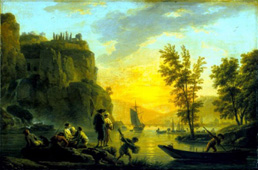
Summer
Evening, Landscape in Italy 1751
to
the right, mountains covered with trees and wild shrubs
|
The
second site
in shadow, as travellers would say.
In half-tone, as artists would say. Diderot immediately
brings up the subject of the connection between perception
and its recording and judgement. The second site is
explored in a much more systematic way than the first.
Diderot notes a passer-by too keen on travelling
to take in the scene. . but . . .' (we) penetrated further
into a distant prospect well beyond the mountain we'd
climbed which had previously blocked it from our view'.
Diderot wants to get past the 'view' and into the very
scene of the viewing. His companion remarks on passing
a particularly dramatic scene . . . and Louthenberg,
and Vernet, and Claude Lorrain? . . . Diderot invokes
the dualism of fear and pleasure in nature and the spectacular.
|
|
|
To the left and
right, the foot of mountains, to the left a wide, dark
cavern
|
Diderot sees a cave and immediately imagines
a young boy and girl emerging. She has covered her eyes
with her free hand, as if she feared the light and wanted
to encounter the young man's gaze.
|
|
|
On the bank of
the lake a woman rests with her dog
further, on
the same bank |
|
a group of
men and women such as an intelligent painter would have
imagined them. |
Diderot second guesses the painter's intentions.
He pre-empts his decision making, he steals his thunder.
Diderot is stupefied.
|
|
|
I was motionless,
my glance wandered without pausing at any single object.
|
Silence,
solitude, suspension of time, the eternal, the immense,
the vast : all the main characteristics of the grace
of stupefaction and the sublime are here.
Burke
talks of the passion caused by the Sublime.
|
|
|
'The passion caused by the great and sublime
in nature, when those causes operate most powerfully,
is astonishment; and astonishment is that state of the
soul, in which all its motions are suspended, with some
degree of horror.'
|
'The passion caused by the great and sublime in nature,
when those causes operate most powerfully, is astonishment;
and astonishment is that state of the soul, in which
all its motions are suspended, with some degree of horror.'
Burke sees the sublime as a state of mind attained
when all other matter is dismissed. Admiration, reverence
and respect are secondary effects to Astonishment. Burke's
introduction to his topic states quite clearly that
his intentions are centred around power, developed and
itemised in terms of qualities and quantities of terror
and dimension.
Burke speaks too of the passion
caused by the Sublime. Astonishment in the soul results
in horror, a state of being where the mind is entirely
filled with horror - there is no space left for entertaining
any other notions. Burke's notion of a space entirely
filled with horror is impressive in its inclusivity,
but unconvincing as a reality. Horror itself must have
its own scales of grandeur or otherwise. Astonishment
therefore is the highest power imaginable - though lesser
ones are admiration, reverence and respect. Burke develops
his idea of terror into the hermeneutic sphere. Fear
robs the mind of rational thought. It is an apprehension
of pain, and therefore resembles actual pain. With regard
to sight, what is terrible is also Sublime. The Sublime
is dangerous. Terror is linked to size, to largeness,
such phenomena as oceans and deserts. In contrast to
this mental and figurative excess, the discursive terminology
used to describe these effects must be used sparsely
- there is no room for hyperbole, which would lessen
the effect, not accentuate it. For Hyperbole, though
it implies an intensity of feeling inside the metaphor,
also violates the decorum in that it distorts the truth
by saying too much. It expands the sense of the meaning
to such a degree that its frontiers fracture and it
virtually invites trespass. But like many transgressions,
it is committed in order to be discovered and punished.
It craves 'the oxygen of publicity'. It insists on its
own notoriety and demands investigation and reportage.
Yet there is no intent to deceive here. Diderot uses
the device to put the reader in authority. The author
charges the reader with the responsibility of calculating
the level of compensation necessary to estimate the
difference between the claims of the hyperbole and the
experiences that the author assumes that the reader
is in command of. So Diderot's hyperbole is a trope
of difference and proportion, which while defying decorum
in one aspect, invents a new decorum of contrivance
between author and reader, and introduces another possible
problem of the author being cast adrift if that understanding
is not forthcoming.
Burke continues his own augmentation.
'To make anything very terrible, obscurity seems
in general to be necessary'.
He sees the paradox
of the diminishing returns of description and clarity,
for clarification of the nature of the force involved
only results in its diminution. Understanding the danger
makes it appear less dangerous. This 'unknowing' is
part of the nature of the danger. Burke develops his
notion of this 'unknowing'. He sees reasons in nature
why the obscure idea, when properly conveyed, should
be more 'effecting' than the clear. Ignorance of things
is a quality that causes our admiration and excites
our passions. Knowledge and reason dilute the terror.
A
gain Burke evokes
rhetoric when he makes a rather startling statement
[ in the sense that it 'suddenly' appears in the argument]
that 'Vulgarity is a form of unknowing.' Burke sees
that a multiplicity of images heaped on each other creates
a feeling of confusion and emotional turmoil. As a critique
is applied to them, and their relationships and functions
become apparent, they lose this blur, they lose their
obscurity. Continuing his excursion into the figural,
he offers the sense that painting deals with mimesis,
and much of the pleasure of painting is in this recognition,
and that often in nature the hazy, the dark and the
indistinct produce grander passions than the lucid and
the clear. [ Throughout this comparison Burke has recourse
to the figural in his description of both painting and
poetry]. Greatness points towards infinity. It cannot
perceives its bounds. To perceive an object is the same
thing as to perceive its bounds. When painters try to
give clear representations of the terrible there is
always a problem with tragedy resembling farce, when
the very striving for the earnest results in the grotesque.
He would sympathise with Diderot's dilemma, that painting
has no temporal dimension, and terror is a temporal
phenomenon. Seeing all the elements at once is akin
to listening to the notes of a cadence simultaneously.
Burke is now beginning to move around the edge of his
own canvas. He expresses the authority of height over
length . . .
|
|
|
'To the sublime in building, the greatness
of dimension seems requisite . . . no greatness in the
manner can effectually compensate for the want of proper
dimensions. Too great a length will mean the perspective
is lost'
|
'To the sublime
in building, the greatness of dimension seems requisite
. . . no greatness in the manner can effectually compensate
for the want of proper dimensions. Too great a length
will mean the perspective is lost'
As a quality
of the sublime, physical largeness is a major value,
though smallness and even minuteness [proportion again]
can also have the quality of the sublime in terms of
contrast. |
|
|
'Might is an ability
that is superior to great obstacles. It is called dominance:
if it is superior even to the resistance of something
that itself possesses might' |
Kant introduces the category of the Dynamically
Sublime. The arousal of fear is the primary quality
of this sub-division. But fear is a quality that is
best judged and appreciated from a position of safety.
From this position terror and fear can safely be analysed
and various gradations and categories delineated and
tabulated. Indeed, the greater the safety, the greater
the augmentation of this fear factor. These graduations
mirror a complementary scale of 'gladness', of appreciation
of safety and well-being, of liberation from danger.
Kant introduces a sequel [echo] to Diderot's description
of Vernet's painting ' On the other hand, consider bold,
overhanging and, as it were, threatening rocks, thunderclouds
piling up in the sky and moving about accompanied by
lightening and thunderclaps, volcanoes with all their
destructive power, hurricanes with all the devastation
they leave behind, the boundless ocean heaved up, the
high waterfall of a mighty river, and so on.'
Kant
defines the Dynamically Sublime in terms of our relationship
with fear. On the one hand there is our terror and fear
when confronted with nature, and on the other hand our
desire not to be dominated by these forces, but to be
able to judge them and consequently our ability to come
to terms with them by calling on our own strength to
overcome these very terrors. The terrors that nature
can conjure up therefore excite our imaginations to
overcome and elevate ourselves above nature itself.
So the dynamic is the imagination, the ability to see
outside the terror, to place it in our own context,
not just the natural world's.
|
|
Diderot cries out.
He shatters the solitude
by now feeling the need to express to nature what it
is showing him. The beholder speaks back, giving nature
its gift of astonishment. there is an economy here,
a tacit agreement of what worship requires and donates
to the beholder.
It's a fictional view one has to believe
exists somewhere.
Diderot plays with the beholder. This
is the very scene, but is it possible to know this?
Diderot now constructs a stage set out of the assorted
scenic bric-a-brac he finds to hand to hang his argument
on.
|
|
|
There is a vertical plane balanced on two
mountain peaks
The space above is in light
the
space at the sides is in shadow |
Again,
Diderot describes the scene in terms of a composition
, made up of tones, half-tints, darkened areas - that
is areas deemed to have been altered, and constructed.
The mezzo-tints render the scene in a display of systematic
tonality. There is a perfection too in this very substitution.
There are objects which are clear and distinct, and
there are other objects which could have these qualities
too if their importance was thought necessary.
|
|
|
There are cool waters in the foreground
the suggestion of heat in the background |
Diderot fantasises, then comes out with
How
remarkable how the artist has created the aerial perspective.
Diderot
needs his companion, the Abbé, to be shocked
by this naming of a pictorial device to describe the
scene. He has substituted a construction of a landscape
for the real thing, therefore producing a painting independent
of the work. Diderot is actually describing a garden,
a scene somewhere between the illusionary and the real.
A place where gamesmanship and deceit can be played
out for real.
|
|
|
Following the shore of the lake
Night
was beginning to fall
they retraced their steps
back to the chateau.
|
By way of a coda, Diderot describes the
recitation of passages from virgil that the two children,
who were not allowed to accompany the two on the scenic
part of the journey, had learnt by heart. Diderot uses
this narrative device to allow him to compare
the differing charms
of painting and poetry.
Diderot mirrors Poussin in his mixture
of allegory and fantasy. Again Diderot resorts to the
use of the dream as a way of describing reality without
having to be part of it himself. Diderot treats the
dream as a landscape painting, and like his criticism
of these, he wants to be seen to be part, to take part
in it.
'I
dreamt of the different charms of painting and poetry:
of the difficulty of rendering into one language the
passages one understands best in the other.
Diderot launches into
a long description of Jupiter's headache. Jupiter's
headache is eased by the birth of Minerva. She enters
the world through his mouth, and in full battle-dress.
Though everyone admired her beauty, her dress was the
centre of discussion. Jupiter had his daughter try on
all of these garments, but it was universally decided
that the original dress was superior.
Diderot tells
us that the Abbé had no difficulty in understanding
the point of the fable, but he makes no effort to explain
its place in the text to his readers.
|
|
|
The Abbé is 'blinded' by a dust storm |
Diderot
sees the event as a occurrence which 'marks a point',
a happening which anchors a particular experience to
a place or a moment in time, as Cicero's memory system
used symbols to mark every fifth or every twentieth
room. This is further developed by continual changes
of tense. Diderot challenges the rights of these events
to disturb the order of nature. Or, paradoxically, are
these events too part of the 'order'. Is there anything
outside of this state of affairs? Diderot develops this
into the nature[!] of chance and probability.
|
|
|
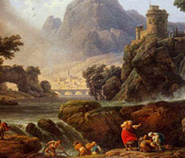
An Italian Landscape
1758 |
The
third site
|
|
Diderot and the Abbé rest on the shore
of a cove
There
is a chateau whose garden slopes down to the sea |
In fact the starting point of the promenade.
The walkers are tired. Instead of retracing their steps,
the group hire a skiff and row back across the bay.
Of course this has the effect of showing them a mirror
image of the scenes they have experienced.
|
|
|
They again pass the cave. |
As
they do so Diderot threatens to invent an incident of
storm and disaster. It would have brought the cries of frightened
women from the terrace to your ears.
He
returns to his theme of the beholder in his emphasis
on the feelings of the watchers of the tragedy rather
than the feelings of the victims. The victims are to
experience their terror through seeing the frightened
cries and anguished demeanor of their women on the shore.
But suddenly the storm has abated. It was a dream -
or rather it wasn't a dream, it was a fiction. Not even
a real fiction, but an imagined fiction, a threatened
fiction.
Diderot's writings are full of examples
of his experimentation with various forms of narrative.
He was particularly fond of the 'duologue', but in 'Conversations
with the Natural Son' Diderot invents a scenario where
characters, actions and thoughts could at any one time
be written and read as being either Diderot's own thoughts,
the thoughts of his companion, the writer 'Diderot',
or the thoughts and fancies of the writer's various
characters - in reality as it were, or in 'character'.
|
|
This is a brief résumé of conversations
with the Natural son
'Diderot' took a break in the
country, [a similar situation to the salon piece itself
] and heard from several quarters an extraordinary story,
that of
a man who on the same
day had risked his life for another, and at the same
time given this other person all his wealth and the
woman who was the object of both their passions. This
man was Dorval, who 'Diderot' then befriends. Dorval
relates to him the strange tale of events that happened
in his family, 'Diderot' finds that Lysimond, Dorval's
father, has suggested that he write a drama based on
the events. This would be for a private performance.
in fact it is not really a 'play' at all, it is a masque,
a ritual, performed in the actual house in which the
actions originally took place.
However Lysimond
dies before the play can be performed. Notwithstanding
this the other characters in the play plan a performance,
each playing 'themselves'. there would be no audience,
except 'Diderot', who Dorval, as a favour, allows to
watch the play unseen from a hideaway. The 'text' of
The Natural Son then follows.
The 'novel' then resumes.
'Diderot' explains why he could not see the last act.
Dorval's father, Lysimond had been held captive by the
British. The sight of the character 'Lysimond' [played
by an actor] in prison clothes and in a bad state had
so upset the actors that they were unable to carry on.
'Diderot' was moved more by this interruption of reality
than of the actual play itself. he asks Dorval for a
copy of the text of the play which he returns to him
with remarks and questions written in the margins. They
become friends and spend time together walking in the
country discussing their ideas for a new kind of theatre.
This turns out to be a form of natural realism where
the actors talk and react to each other rather than
address the audience as in the Comédie française,
and where the action takes place without the conscious
awareness of an audience. There is a discussion of the
virtues of the tableau over the coup de théâtre,
and there is a visionary discussion on continually changing
scenery and contiguous and synchronised action.
Dorval insists that what he has written is not a play,
since the realistic portrayal of events was its raison
d'être. When 'Diderot' criticises a piece of dialogue,
Dorval agrees with him, but argues that since the dialogue
was a true record of an utterance made by the character
in real life, it was incumbent upon him to reproduce
this in the 'play' even if a more verbally satisfying
solution presented itself. Put another way, the play
might have been better if things had happened differently.
|
Diderot's use of conversation and duologue
is widespread in his work. Le Fils Naturel and the Salon
of 1767 have many qualities in common . . . . .
. . . . . Dorval insists that what he has written is
not a play, since the realistic portrayal of events
was its raison d'être. When 'Diderot' criticises
a piece of dialogue, Dorval agrees with him . . . .
. . . During this sequence of the conversation we are
aware that it is 'Dorval' who is addressing us. Diderot
uses this ploy as a means of doubly assuring us of the
authenticity of his views,
. . . . . Here is what we said.
But what a difference there is between what Dorval said
to me and what I write!
for it is a character in[side] the
play that is addressing us, a figure that is at any
one time both 'in character' and 'himself', only differing
for us in the imaginary differences that we may choose
to invent for him.
. . . . Diderot talks about his
own work in a seemingly objective way through the voices
of Dorval and 'Diderot' . This too is a prismatic reflection
of the style Diderot selects for the play itself, but
whereas in the play itself Diderot forces the characters
to mimic each other to death [Lysimond is a metaphor
for this - he dies for the play, for diderot to live
. . . a sacrifice] in the real life, the sunny uplands
of the 'Conversations', Diderot allows [himself, 'Diderot']
the liberty of being both inside and outside of his
own persona.
Dorval,
who is portrayed as a rather passive character in the
drama, does come to life in his role as the conversationalist.
Did Diderot purposely write his character down, so as
to write him up in the novel? Is Diderot suggesting
that a figure is more interesting in reality than in
character - that it is the quality of the author's text
which can seek to elevate them back to and beyond their
real 'role' in life?
|
|
|
|
'The performance was so life-like that, forgetting
at several points that I was a spectator, and an unseen
one, I was about to leave my place and add real character
to the scene'
|
What does Diderot, or even
for that matter, 'Diderot' mean by 'real'? 'Diderot'
is often tempted to unmask himself [both physically
and literally] and join in the action. He
|
|
|
In 1765 Fragonard exhibited 'The High Priest
Coresus Immolates Himself to Save Callirhoë '
The subject derives from Pausanias' Description of Greece.
Calydon spurns love of the priest Corseus / she is beset
by plague of madness initiated by Callirhoe / Dionysus
instructs Coresus to kill Callirhoe / instead, Corseus
kills himself.
Diderot was commissioned to review
the work, and the resultant piece was published in the
Salon of 1765. Due to a misunderstanding over the Louvre's
opening hours Diderot was unable to see the picture
itself, but wrote a review of it in the double conceit
of an imaginary dream. The subject of this dream was
a morning spent at the exhibition and an ensuing evening
reading Plato.
'It seemed that I was enclosed in
the place known as Plato's cave. It was a long and gloomy
cavern. I was sitting in the midst of a crowd of men,
women and children. We all had our feet and hands in
chains and our heads so firmly fastened by wooden clamps
that it was impossible to look round. But the thing
which surprises me was that the majority of my fellow-prisoners
were drinking laughing and singing, not seeming in the
least troubled by their chains, and you would have said,
so far as appearances went, that it was their natural
situation in life and they had no desire for anything
different. It even seemed to me that people looked rather
hostile at those who tried to free their feet and hands
or head or help others to do so; that they called them
evil names; that they shrank away from them, as if they
had an infectious disease: and that, when any mishap
occurred in the cave, these would be the first to be
blamed. Installed in the way that I have explained to
you, we all had our backs turned to the entrance of
this habitation and were only able to look at its far
end, which was hung with an immense canvas or curtain.
Behind us there were kings, ministers, priests, doctors,
apostles, prophets, theologians, politicians, rogues,
charlatans, makers of illusions, and the whole troupe
of merchants of hopes and fears. Each had a supply of
little coloured and transparent images, of the kind
suitable to their own condition: and these images were
so well constructed, so well painted, so numerous and
so varied, that there was all that was needed to represent
every scene of life, comic, tragic, or burlesque. These
charlatans, I then realised - placed as they were between
us and the entrance to the cave - had hanging behind
them a great lamp, to the light of which they exposed
their images; and the shadows of these latter, passing
over our heads and growing in size as they travelled,
were cast upon the great screen at the end of the cavern,
forming whole scenes - scenes so natural, so true to
life that we took them for real. Sometimes they made
us laugh, till we split our sides; sometimes they made
us weep salt tears - a fact which will seem less strange
to you when I say that behind the screen other subordinate
rogues, in the pay of the former ones, supplied these
shadows with the voices, the accents, the speech appropriate
to their roles.
The screen at the end of the cave
is filled with figures weeping, laughing, gambling,
drinking, singing, revelling. One is drowning, one is
being hanged, a third is being placed on a pedestal.
The screen clears and the story begins to unfold.............................
a young priest of Bacchus appears, ivy-garlanded and
bearing a thyrsus. He serves beakers full of wine to
a group of Maenads, and all grow drunk and rush through
the streets to the fury of the citizens. The priest
is then seen trying to seduce a woman, who treats him
with scorn. By now all the citizens are drunk too and
engage in an orgy of incest. Some old men, untouched
by the fracas, are seen in a Temple. They are weeping
and beating their heads on the floor when a loud voice
proclaims 'She must die, or another die in her place'.
The walls of the Temple fall away revealing the floor
which is covered in rich carpets. To the right is a
sacrificial vessel and on either side huge towering
columns of white marble. There is a black urn half draped
with bloodstained cloths, a giant candelabrum, an altar
and a brazier. The high-priest Corseus now appears and
utters a cry (which draws an answering groan from Diderot).
Next, a young woman appears, trembling and as pale as
death, for she is the sacrificial victim. Meeting the
priest Corseus, her lover, she sinks to the floor. Three
acolytes enter, one of amazing beauty. As the sacrifice
is prepared, the Temple fills up. The priest raises
his knife and... thrusts it into his own breast. All
watch thunderstruck as the chill of death falls over
him. Even the aged priests 'whose cruel regard must
often have fed on the vapour of the blood shed at altars',
cannot withhold their tears . . . . .'
Diderot pictures
human life as a series of a captivating but essentially
trivial scenes of passion, cruelty, and superstition
devised by mountebanks, a condition that, as humans
ourselves, we are incapable of ignoring. Diderot attempts
to not only imagine Fragonard's painting , but to imagine
the creative process, the decisions, the exclusions
that it underwent. In doing this he recreates the critical
function too. He criticises the painting as it exists
in its various stages, and also revises his own opinions
in the light of the various (imaginary) developments
that the painting moves through.
|
was not able therefore to adequately separate
himself, as an entity, from the play itself - he had
therefore lost the ability [right] to enter into any
critical relationship. In the same way, in the scene
when Lysimond [played by an 'outsider' {an actor}] enters
and the rest of the cast are overcome with grief to
the point that the performance is abandoned, again shows
this lack of 'space' between reality and fiction - in
the sense , as diderot talks about in The paradox of
the actor, that the actors are not totally 'in character'.
There is something of their persona that refuses to
go inside the character, and there is some of the character
that the actor is unable to contain and has to egress.
The 'old man' plays Lysimond [real time] acting out
lysimond's actions [history]. The other actors are unable
to continue, so deep is their grief. But what is subject
of the grief's desire? Is it the grief [surely already
consummated] for Lysimond's return from capture? Or
is it the imagining of the emotions unleashed of an
'undeceased' Lysimond coping with the re-enactment in
the play of his emotional return? Is it the pathos that
the actions of the old man in imitating the role of
the dead Lysimond that are so unbearable to the rest
of the cast?
Diderot is making a distinction between
a public effect, [such as a history painting] and a
private performance, [landscape, still-life], perhaps
anticipating what was to become known as a soiree, in
which the performance, though containing a 'text', was
essentially made special by the difference and uniqueness
of that performance [at that time, at that date, in
those rooms etc.]. In his Paradox, Diderot goes further
and explains that there is a difference in relation
to acting in fiction and feeling the effects of (say)
tragedy in reality
. . . . Have you ever
been Cleopatra, Merope, Agrippina? What do these people
matter to you?
Diderot is moving towards the scene of decorum
and the proper, towards a rhetoric for the theatre,
for the soiree, for nature itself. In each of these
there is an economy of means, a compromise, and some
sacrifice of the truth of nature.
Diderot describes
himself walking away from the play when it is abandoned
after the second act [another instance of the promenade]
. . . .
. I must be a fool to get upset like this. All this
is just a comedy. Dorval made it up out of his head.
He wrote the words from his imagination, and today we
are amusing ourselves acting it out.
Diderot tries to imagine
the play as fiction, but fails. But this 'failure' is
fiction too. The melodrama that ensues is a supplement
to the action, it could even be thought of as a coda,
or more fanciful [as Dorval would desire it] the culmination,
the last variation 'con brilliante'. In procuring the
dénouement, of positioning it outside the drama
itself, Diderot prevents the reader from entering the
same relationship to the text as the characters have
to the drama, and therefore insists that the spectator
enter the disputed territory, of the private/spectacle,
order/subversion in person.
At one point Diderot
also takes his players, 'in character', out of the drama
altogether, and moves them into the critique. 'Diderot'
is discussing the merits of a particular scene in the
play
.
. .What a fine tableau, for it really was one, I think,
was made by Poor Clairville, lying on his friend's breast,
as though it were the only refuge left to him.
Diderot allows
Dorval to interrupt -
You may well think of his troubles, but
what about mine? How cruel that moment was for me!
the interruption
referring to an action in his own life and its resemblance
to that of a scene in the drama, so therefore breaking
the hymen of the critic's thought of the text as 'the
last word'.
Dorval's
play can only ever be an impression of the play. we
are not seeing 'what actually happened'. In fact in
the introduction Diderot makes it quite clear that 'Diderot'
is aware of this, which of course introduces the reader
to the first signs of a rift between the real and the
dramatic
. . . . but what difference there is between
what Dorval said to me and what I am writing!
The
exclamation mark is a taunt.
I can no longer see
Dorval, I can no longer hear him. I am alone, amid the
dust of books and in the darkness of my study .......
and the lines I write are feeble, sad and cold.
By using
Dorval as the 'fountain of knowledge' and 'Diderot'
as 'the inquisitor', Diderot is able to depend less
on, and even give the impression of not caring about,
the narrative development of an exterior plot. He is
more concerned in creating an alternative interior narrative
which takes as its subject the accommodation, harmonisation
and reconciliation of Dorval's and 'Diderot's' concepts
of the real and the imaginary.
|
|
River Landscape with
a waterfall 1762
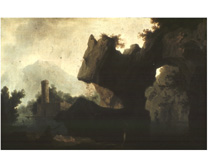
Rocky river landscape
1763 |
fourth site
|
This
is treated in a far more impressionist manner. The linearity
falls into disrepair, the sightings are more random,
the scenario less systematised, the objects less distinct.
Gone are the geographical and athletic references. Instead
there is a more reflective style of writing. The observations
become more conversational, more generalised, more allegorical,
less picturesque. He rests his eyes on the landscape
rather than travels around it, and he begins to put
more emphasis onto reflection rather than mere observation.
Vernet's
paintings were not portrayals of actualities. They were
combinations of fragments of reality reconvened to give
a particular effect. these were fully convincing and
were in accord with the laws of nature. Diderot felt
that vernet had an instinctive knowledge of nature's
laws, and therefore was able to summon up the correct
'piece' to insert in the jigsaw at any time. he was
master of his own game. Diderot is seeing in Vernet's
painting method a relationship between composition and
precomposition, a type of serialism in which the actual
landscape was the starting point in terms of a sense
impression, a 'ground' ['grounds' in terms of legitimisation
too] on which to improvise. Imitation is at the service
of expression. Vernet's role as the painter is seen
as an inspired mediator between art and reality - which
Diderot celebrates in the salon in the double pun of
'the point of view'. As Diderot infiltrates Vernet's
picture space, he recreates the experience itself through
experiencing, with us in company, its reconstruction.
Diderot asks us to take on the role of the eyewitness
- not in the observance of nature, but of the witnessing
of the verification of the moment of the sensation when
art and nature are the same. He is asking us to take
the place of condillac's statue, to be a vessel, a mute,
to which the artist can attach the various sensations
which allow us to see his vision, to allow us to make
our own representation through his eyes. So the reader,
the viewer, is not allowed to see just the finished
result. But the spectator is allowed to become totally
absorbed in the aesthetic experience. Inside this construction
was an understanding that though the work may live through
the deceiving of the eyes, through its representation
of a three dimensional world in two dimensions, the
emotions were not to be part of this: there was always
an inside and an outside here, always a line , a frontier
of demarcation. In this sense, the spectator's entry
into the picture is not illusion. The success of the
work depended on total absorption in the process of
looking at the work. Diderot was insistent that nothing
was to intrude between the spectator and the painting.
The painting should have a dominating idea and nothing
should distract the beholder from the central concept.
Flamboyant brushwork and allegory should also be sacrificed
to dramatic unity. These were distractions that inserted
a membrane [member] between the work and the spectator.
The spectator had firstly to decipher its meaning, engaging
the mind before any emotional responses could flourish.
The ideal work of art is therefore one in which the
spectator feels the same emotion as s/he would do in
reality. The artist must never therefore admit to the
presence of the spectator, [which diderot overcomes/subverts
in the Conversation on the Natural son], otherwise the
latter's emotional involvement could waver. Diderot
praised Vernet's concentration on a single recognisable
pictorial idea for its ability to encourage this behaviour.
Pictorial conventions could not necessarily on their
own ensure enthralment. The subject was of equal importance.
It was essential for the viewer to be made to feel sympathetic
[in sympathy] with the subject, to make him identify
with the issues. diderot gives a list of subjects which
he feels have 'universal substance', subjects which
may encourage the suspension of difference between art
and reality. But this rationale relied ultimately on
the desire and will of the spectator to want to enter
a state of empathy, to want to be part of the 'scene':
the artist requires the complicity of the viewer. More
than this, it was essential to stimulate the viewer's
imaginative and creative responses to the work. In fact
their participation. The viewer can then extend the
imaginative perspective of the work [which by its very
nature will be edited] through their own imaginative
resources, controlled of course by the same rules and
regulations [sententious > sententia maxima >
maximum meaning] which the work will have literally
or subconsciously ingrained in the viewer's rationale.
Diderot is arguing that the 'art object' was only half
of the event. the other half contained the potential
of the spectator's imagination [an undefined quantity],
giving rise to the notion that all art is 'left open',
that the artist's signature, the 'signing off', is a
moment of egress, not termination. This new emphasis
on the imaginative response to a work of art let in
the concept of interpretation, and the consequent notion
that there were as many interpretations as there were
viewers. It is interesting to note too the beginnings
of the interest in the sketch. Previously thought to
be merely a means of gathering and recording information
for attachment to later, constructed, and considered
views, these became documents of interest in themselves.
For they were seen as documents containing, without
egress, the very essence of the 'scene', unadulterated
by any 'thoughts' or intellectualisation. They were
an essence, a perfume. They were 'fresh' and 'natural'
responses, as if the very act of working from them diluted
their innocence. This innocence had a temporality -
as if it diminished as the time between the act of drawing
and that of painting expanded. by their very nature[!]
they were often unfinished, therefore 'left open' for
the viewer to [countersign] continue in their imagination
their own development and conclusions, or even their
concept of where the artist's imagination may have led
them. At the same time this allowed the spectator to
gain a privileged 'view' of the 'artist at work', to
continue, without any barrier of public presentation,
the innermost, private reveries of the artist, which
became one of the central themes of the romantic period.
This notion of egress encourages the anticipation of
the dream, the continuance of the visual effect back
into a spoken /written narrative. This naturalistic
setting invokes the reverie, a state which alters the
previously static relationship of observer and observed
.
Diderot also hints at the notion of the involuntary,
the incapability of the spectator to escape the painting's
advances, and the implication that the more irresistible
the painting is, the more its philosophical value, and
that this desire is something that is in ourselves,
and that the work of art is a catalyst to the unveiling
of these thoughts and emotions. |
|
Diderot - Conversations
on the Natural Son - second
conversation
'The
next day, I went to the foot of the hill. It was a lonely,
wild place. The view was of a few hamlets spread out
over the plain; beyond, a range of irregular, jagged
mountains which formed a part of the horizon. We were
shaded by some oak trees, and the muted sound could
be heard of an underground stream flowing nearby. It
was that season when the earth is covered with the fruits
it grants to the toil and sweat of man. Dorval had arrived
first. I went up to him without him noticing me. He
had abandoned himself to the spectacle of nature. His
chest swelled out and he was breathing deeply. his eyes
were fixed on everything around him. I could see on
his face the various impressions in what he saw, and
I was beginning to share in his rapture when I cried
out, almost involuntarily " He is under the spell". |
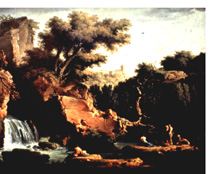
Landscape with a waterfall
1761 |
The sixth site
|
|
In the distance,
To the right
the top of a rock disappearing into
the clouds
In the foreground, an old building, an
arcade leading to a lighthouse
behind this , a range
of hills
To the extreme right, a waterfall
To
the left, a promontory with fishermen going about their
work
On the promontory, a forest
to the left
a rock, a stone building, an inlet of the sea
To
the right, the lighthouse and the sea stretching into
infinity |
If
you do not make an effort to reconstruct this site to
yourself accurately, you will take me for a madman when
I tell you that I uttered a cry of admiration, that
I was left motionless and dumbfounded . . .Oh nature,
how great you are! Oh, Nature, how imposing, majestic
and beautiful you are!
|
Diderot is in agreement with Burke in their connecting
of Infinity and terror - They both connect the sublime
with a venture into the unknown, the possibility of
a psychological space inside the spatial, perspectival
ordering of objects in illusionistic space. The notion
of 'ordering' is seen as a condition of the sublime.
A great profusion of things which are splendid in themselves
are magnificent. Apparent disorder also creates a sense
of grandeur. In the opposite direction Burke goes so
far as to say that
'The appearance of care is unhelpful
to the portrayal of magnificence'.
This apparent
confusion creates the illusion of infinity, a place
where perspective and visual laws, agreements, vanish.
Burke then goes on to consider power. Magnificence and
Power. Pain, he claims, is much stronger than pleasure.
Pleasure is 'stolen' from us. Pain is submitted on us,
against our will. Strength is beautiful when controlled,
it becomes sublime when it is acting against our will
and gets out of control. Magnificence and Complexity.
A quality Burke associates with the sublime is that
of difficulty. Burke uses the example of Stonehenge
to suggest that objects that are obviously the result
of toil and struggle have a grandeur [the rudeness,
and as before, the vulgarity of the work] that approaches
the sublime. Dexterity has the opposite effect, that
of reducing the task to that of mere manners.
Burke
again has recourse to the figural when he considers
light. 'Colours depend on light'. A rapid change from
light to dark can astonish, but darkness is judged to
have more of the
Sublime
than light. Burke quotes from Milton. 'Dark with excessive
light thy skirts appear'. Extreme light, by overcoming
the organs of sight, obliterates all objects, its effect
resembling darkness. Thus two ideas as opposite as can
be imagined are reconciled in the extremes of both,
their opposite nature brought together in producing
the Sublime.
|
|
In addition to this description of objects,
Diderot makes special note of the atmosphere and lighting.
Closer to us
all colours remain distinct, while in the distance they
blend together and soften, their fusion producing a
dull white
and,
. . .
a patch of forest lit by light originating from its
far side
|
Burke writes an account of his notion of
vision. He gives two contrasting theses. Vision is performed
by having a picture formed by the rays of light which
are reflected from the object, painted in one piece,
instantaneously on the retina, or least nervous part
of the eye.'
'Or, according to others, there is
but one point of any object painted on the eye in such
a manner as to be perceived at once; but by moving the
eye, we gather up with great celerity, the several parts
of the object, so as to perform one uniform piece.'
Burke then conducts an argument between these two propositions.
He makes out a case that the physical act of perception
causes pain, and is therefore part of the sublime. His
argument suggests that light from a large body strikes
the eye in an instant. That body is made up from a multitude
of small points, the rays from which make this effect
on the retina. So that all these minuscule strikes on
the retina add up to a bombardment, which shakes the
retina to such a degree as to cause pain.
His explanation
of the second thesis is that if only one point of an
object is visible at any time, the eye must scan these
with 'great quickness', and consequently this will result
in muscles being stretched and strained to a point of
pain. Both explanations result in the construction of
a vibratory, uncertain domain where vision is created
in an environment of tension and unease.
|
|
This domain is realised in Burke's mind by
the contemplation of darkness. Defying Locke's conjecture
that darkness is 'not naturally' an idea of terror,
Burke sees darkness as a place of uncertainty, a place
in which mankind cannot know in 'what degree of safety
they stand'. This inability to see potential danger,
the ignorance of surrounding objects, and the inability
to detect potential foes forces the unfortunate to pray
for light. Burke suggests that darkness and blackness
are virtually indivisible, though blackness may be used
in terms of confined spaces. He gives an example of
a newly sighted person being disquieted by seeing blackness.
Blackness, Burke defines as but a partial darkness.
It derives its powers from being 'not black' and also
from being surrounded by other colours.
|
Closer to us all colours
remain distinct, while in the distance they blend together
and soften, their fusion producing a dull white
and,
. . . a
patch of forest lit by light originating from its far
side to
be transitory, to have a temporality similar to terror,
which to continue its effect must be used infrequently.
When the terror abates 'smoothness and glossiness' will
dissipate it, and modify the starkness of the original.
|
It is in the sixth site that Diderot 'owns
up' and discloses that these visits have been pure fiction,
that the subject of his gaze was in fact Vernet's paintings.
|
|
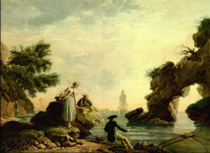
Landscape with a fisherman
1763 |
seventh picture
|
This
essay is entitled 'picture', as distinct from the previous
six 'sites'. Diderot declares that he is no longer addressing
the Abbé, he is addressing the reader directly.
This is the most complex site in terms of loci. Backwards
and forwards moves the shuttle, concocting the correct
nuance from the various narrative strands.
|
|
1 In
the centre the moon is floating above the horizon, intermittently
hidden by dense cloud, creating a scenario of the lit
and the unlit, and the drama of the movement between
them.
2 To
the right i a
building
ii forward
from this, some abandoned pilings
iii forward
to the left, a boat
3 further
back a sailing vessel advances
towards the building
4 to
the rear limitless expanse
of the ocean
5 far
left i steep
rocks
ii beneath
which the esplanade begins
6 far
right esplanade
finishes at fountain.
7 Inside
this area, Diderot describes the position of a multitude
of characters, and he goes on to surmise their
relationships and likely employ. |
The position of objects is now described
in relationship to each other. Diderot then interjects
one of his favourite devices [devices, as in signs],
that of analepsis, the restorative, the invigorating,
the stimulating analeptikos , the cure. The cure for
the art is the looking. The cure for the looking is
the painting. Diderot then begins to effect the position
of the painter, or at least a position in between Vernet's
initial impulse and his compositional decision making.
. .'
|
|
|
'Forget
the right side of his Moonlight, cover it up so that
you can see only the rocks and the esplanade on the
left, and you'll still have a beautiful picture. Isolate
the portion with the sea and the sky, with the lunar
light falling on the water, and you'll have a beautiful
picture. Consider only that portion of his canvas with
the rocks to the left, and you'll still have a beautiful
thing. Content yourself with the esplanade and what's
happening on it, look only at the steps with the various
tasks being carried out there, and your taste will be
satisfied. Cut out only the cistern with the two figures
leaning against it, and you'll have a choice bit of
painting under your arm.
|
'Our aesthetic appreciation of nature
enables us to relate to the world, to understand our
limitations and the possibility of transcending them.
But we are not creators of nature and neither do we
formulate its critique, for we stand outside the nature
to perceive the harmony that exists between our faculties
and the objects on which they employed.'
|
|
Kant, writing 30 years after Burke and Diderot, also
foresaw problems inherent in the idea of beauty. He
saw that the idea of taste was a paradox, that aesthetic
judgement was a contradiction since 'aesthetic' suggests
subjective experience and 'judgement' suggests universal
assent. 'Beauty' could easily be seen as part of the
'object' - a confusion of taste and fact. The pleasure
of the object is intuitive - though it is expressed
in the form of a judgement. Judgements therefore can
be thought of as aesthetic because of their relationship
to direct experience. These judgements must be empirical,
they must have been formed through experience.
Acquiring the judgement of taste would mean a fundamental
premise under the condition of which one might subsume
the concept of an object, and then , by syllogism, draw
the inference that it is beautiful. That, Kant reasoned,
was impossible, for the pleasure must be felt immediately
in the perception of the object, and it is always experience,
and never conceptual thought that gives the right to
aesthetic judgement, so that anything which alters the
experience of an object would alter its aesthetic significance.
Aesthetic judgements therefore should be free from concepts
since beauty itself is not a concept in itself. The
consideration of an aesthetic experience is not judgemental
in the fact that it is the showing, the pointing out
of the particular features that is important, not the
explanation of them. This pointing out is akin to the
notion of taste, a rationalisation of experience in
a communal sense, based on agreement. The notion of
beauty is rationalised too in the communal feeling of/for
pleasure. The idea that others feel as you do is not
derived from experience. It is a presupposition. This
would in part explain Diderot's decision to write this
critique in the form of a conversation, and to involve
the Abbé as a receptacle for the storage and
instant recall of these judgements. Diderot puts forward
the idea that there can not be any one judgement, suggesting
that the judgement consists of a state of thinking about
judgement, of thinking that a theoretical judgement
might be valid, that it would have the possibility of
being seen to be so.
Diderot is clear that the
pleasure in the beautiful, though it is immediate, nevertheless
involves contemplation and reflection, and that aesthetic
pleasure must also have the ability to be communicated
through sight and the hearing, the senses that permit
contemplation. Again, the invention of the Abbé
enables Diderot to emphasise this point, suggesting
to him that the act of contemplation requires that an
object be thought of as a unique event rather than a
universal concept, indeed, that the object becomes isolated
from the world while it is gazed on. But contemplation
is more acute than this. Every 'interest' the observer
finds in the object is noted, is abstracted and stored.
The object is under surveillance. The object is not
an end to its means, but an end in itself. The observer's
desires, aims and ambitions are held in abeyance [inside
the fold] in the act of contemplation. There is a continual
desire for the cycle to remain incomplete, to remain
in limbo where the object can exist in a disinterested
state.
Kant then questions the role of rationality
in aesthetic contemplation. He argues that imagination
has a central role in the synthesis of concept and intuition.
Imagination is double-edged. It turns intuition into
fact, but at the same time requires the fertilisation
of experience with concepts. Kant thought that imagination
could be freed from the rules of understanding.
Kant wants us to take pleasure in beauty in order to
experience the harmonious workings of our own faculties
and to project that harmony towards and onto the empirical
world. We will see in objects the unity we discover
in ourselves. This is the origin of our pleasure. Kant
divides beauty into two categories, and makes a preliminary
judgement on each
being
perceived without the aid of conceptual thought - free
requiring
conceptualisation of the object. - dependent
To perceive a painting one needs to understand the concept
of the content and how it is expressed. This beauty
would be less pure than the 'free' beauty associated
with nature itself.
Nature is a pure beauty. There
is no 'interest', no agenda, no 'purpose'. It produces
feelings in us of organisation, of placement, of the
proper. Kant puts forward a notion that aesthetic unity
displays purposiveness without purpose, to the point
that the experience of looking at objects and judging
them finally discolours our ability to see nature 'freely'.
It makes us look with a purpose. This concept of 'aesthetic
experience' leads us to the notion of 'design' in nature,
and the recognition that the artist in us would want
to use these findings for our own ends.
The aesthetic
idea also imprints on our senses the idea of the transcendental.
The idea of the artist striving to go beyond the limits
of experience to show things in a completeness that
nature does not show. Kant calls this aesthetic condensation.
It is the experience of trying to reach the transcendental
that produces this aesthetic experience - this striving
not just beyond our own imagination, our own experiences,
but beyond our own conceptions. This leads to an aesthetic
experience where we view ourselves in relation to a
transcendental reality which lies beyond the field of
thought. We come to see our limitations and the grandeur
of the world. We perceive the harmony between nature
and our faculties, and by the purposiveness of the relationships
between the two, we experience beauty, but when we are
dwarfed by the enormity of the world, and our inability
to understand and control it, we glimpse the Sublime.
The Sublime is a force. It incites us to abandon sensibility,
manners, rhetoric. Kant defines the Sublime in a number
of ways - 'that the mere capacity of thinking which,
evidences a faculty of mind transcending every standard
of taste', and, 'an object of nature the representation
of which determines the mind to regard the elevation
of nature beyond our reach as equivalent to a presentation
of ideas.' The judgement of the Sublime approaches a
moral judgement too. As the beautiful demands agreement
on taste, in the Sublime we demand the extent the limits
of the experience of the awesomeness of nature. By not
taking the transcendental viewpoint he lacks the basis
of a true morality.
Kant defines the Dynamically
Sublime in terms of our relationship with fear. On the
one hand there is our terror and fear when confronted
with nature, and on the other hand our desire not to
be dominated by these forces, but to be able to judge
them and consequently our ability to come to terms with
them by calling on our own strength to overcome these
very terrors. The terrors that nature can conjure up
therefore excite our imaginations to overcome and elevate
ourselves above nature itself. So the dynamic is the
imagination, the ability to see outside the terror,
to place it in our own context, not just the natural
world's.
Kant develops this further in his divisions
of the mathematically Sublime [Ch. 26] and the dynamically
sublime [Ch. 28]. The Sublime requires a 'mental movement'
combined with an 'estimate of the object'. The mathematically
sublime relates to the need for cognition of the absolutely
great. Small, medium and large are all relativisms,
but magnitude is a judgement, dependent on measure.
Magnitude is always judged in terms of comparisons,
of relatives. The Sublime cannot be judged by comparison.
It can only be judged by its own criteria, that of the
Sublime. Kant states that it is impossible to calculate
the Sublime since both the multiplicity and the magnitude
are unknown. It cannot therefore be computed. Its magnitude
must always be based on comparison and can therefore
be judged only in terms of aesthetics. But these comparisons
must not be the result of personal judgement only -
they must be capable of being upheld by universal agreement.
He puts forward the notion that the 'object' need not
necessarily exist at all, it may be formless, since
only its potential greatness is needed to convey the
judgement of being Sublime. 'Instead of the object,
it is rather the cast of the mind in appreciating it
that we have to estimate as Sublime'. The feeling of
the Sublime is one of dissatisfaction in our inability
to free our imaginations to the point where we can use
reason to judge the Sublime. This restlessness is manifested
in our need to 'set in motion' the quest for the Sublime,
and whereas what is beautiful can be judged in restful
contemplation, the Sublime is always a place of conflict
between imagination and reason. Kant finishes this chapter
. . . . . 'and the object is received as sublime with
a pleasure that is only possible through the mediation
of displeasure.'
|
|
This
reading of Vernet's work, and it is Vernet's paintings
that we are now discussing, describes a work of flexibility
and indeterminacy. Diderot is seeing the work as a series
of 'happenings' which, though they have a coherence
in themselves, have more resonance in groups. On their
own, or in incomplete groups they have a sense of 'absence'
which has a hermeneutic effect on those present. Diderot's
quest for the invention of the labyrinth is echoed in
the Encyclopédie. Diderot answers the questions
posed by the different interpretations of the landscapes
by inventing different ways of talking about them. Different
ways of describing space, and different ways of going
about describing space. Port-Royal logicians contrasted
the narrative 'order of invention' with the systematic
'order of analysis'. Diderot here is offering a presentation
of the anxiety prominent at the time between the sequential,
linear modes of thought and synoptic or temporally organised
ones. Diderot develops his theme of linearity here too
in the developmental devices of his criticism, which
gradually become less and less 'descriptive' in terms
of topography, and more and more daring in the verbal
space they demand. The sequential is in the foreground
at one moment, the background the next. Diderot is inside
the painting, gazing at himself scanning, reading the
work of which he is now a necessary part. . Between
the foreground and background is the terrain, a new
terrain, a scene of gambits and adjustments. Diderot's
path, his pèlerinage, takes the form of a fold,
an arabesque between these surfaces.
The
space between the words, the continual and expectant
need to involve the reader in the process of selection
is a method that Diderot uses to fabricate the empowerment
of the reader - as perhaps he feels Vernet has done
to him. Whereas in the first site Diderot is seeing
the scene 'framed' ready for insertion into a painting,
by the seventh site he is inside the work in a spatial
sense too. He is reluctant to return the 'picture' as
it now has been admitted to being to the frame. He is
trying to disenfranchise this frame, to free both the
painting , the frame and the view, so that any one part
does not have any precedence over the other. The Parergon.
As Diderot foresees Film and T.V. in Le fils Naturel,
so he now envisages the series paintings of Cézanne's
Mont Sainte Victoire and the evolution of Cubism. Is
the Cicerone remembering the future as well as perceiving
the present as he accompanies the Abbé and diderot?
Diderot
then adds some comments about the relative merits, as
paintings, of the various works. The fact that these
are, according to Diderot,
of varying quality,
is a matter of the moment, of the bodily state, of the
state of the soul.
He
gives a few examples of how domestic incidents can divert
the true direction of genius. How seemingly trivial
discomforts can divert the muse.
Chance too plays a
role in chess and in all other intellectual games, and
why shouldn't it here as well? Diderot then 'closes' his piece. . . . . .
.
That's enough
about Vernet
He
concludes by describing two dream sequences. Firstly
though , he lays the foundations for the scene of doubt
by discussing the differences between dreams and sleeplessness-
[perhaps what we are going to hear isn't categorised
properly]. His soliloquy begins with the comment that
No philosopher known
to me has successfully described the difference between
sleeplessness and dreaming.
Was
I sleepless when I thought I was dreaming?
or
was I dreaming when I thought I was sleepless?
Who is
it told me that one day the veil would be rent, and
I'd be convinced I'd dreamed all that I 'd done and
really done all that i had dreamed?
These
two dreams are superficially different in that one is
happy , one is sad. They again use the distancing ploy
in that it is obvious that the imagery comes from Vernet,
they are 'captured' in Diderot's as nature is in Vernet's
paintings. Diderot seems to be hinting at the sublime/inal
In
the Encyclopédie, Diderot compares the qualities
of wit and genius.
. . . . sound, genuine
taste, the sublime in whatever type of art, the moving,
the great effects of fear, compassion and terror, noble
and elevated feelings, and great ideas resist epigrammatic
style and contrast in expression.
and
in the Salon,
anything which astonishes
the mind, anything which inspires a feeling of terror
is conducive to the sublime . . . The night hides the
shapes of things, adds horror to their sounds: even
that of a leaf in the depths of the forest sets the
imagination working, and the imagination troubles the
heart, so that everything is magnified.
Diderot
seems to be offering up a definition of the sublime
as something that 'disturbs' ordered perception. It
produces amazement, awe, bewilderment and surprise.
This is a fearsome, disruptive thing in its ability
to destroy the bases of rational judgement and empirical
reason. It emphasises the spatial dislocation and the
passage of experience through a 'darkness'. It attempts
to bias our value judgements towards the emotional and
against the common-sense/place. If this is to be the
case, and Art is about the sublime, it must therefore
be 'outside' daily experience, and also, possibly, outside
of morality. Diderot himself expressed it as something
which
might well be the opposite
of everyday morality . . . . . . I am very much afraid
that man may be led straight to disaster along the path
which leads the imitator of nature to the sublime.
Diderot
sees the followers of this doctrine as doomed to misfortune
and misery, a precursor of werther and, nearer home,
Dorval.
Diderot
links the sublime with his idea of Enthusiasm.
It
is impossible in poetry, painting, eloquence or music
to produce anything sublime without enthusiasm. Enthusiasm
is a violent movement of the spirit by which we are
transported into the midst of the objects we are to
represent; then we see a whole scene take place in our
imagination as if it were outside us [the cave again]
: and it is, for as long as this illusion lasts, everything
present is annihilated, and our ideas take on reality
in its place . . . if this state is not madness, then
it is very close to it.
This
passage hints at the possibility of the imagination
replacing the reality around us, and the ensuing terror
that may ensue. In his Salons Diderot calls into question the traditional
circuitry of creativity - the initial 'vision thing',
the consequent rationalisation and ordering of this
perception, and the final construction of the art object.
|
|
|